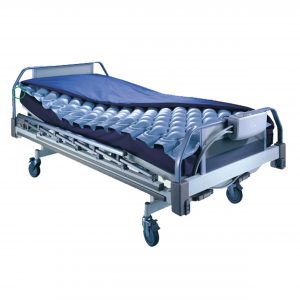
What is a ripple mattress or pressure alternating mattress?
A ripple mattress is a mattress system that is part of or is placed on a hospital bed. Its function is to lower the interface pressure between patient skin and the support medium. It achieves this by uniformly and alternatively supporting the patient contact skin area through air pressurizing of air cushions. There is another device that performs a similar function, called an “Alternating-pressure pad” which is similar to a ripple mattress system but is less than about 9 cm high when inflated.
Ripple mattress systems are typically used when treating patients who cannot move or have limited mobility. Some of the criteria necessitating the use of these devices may include the presence of pressure ulcers or burns patients not able to move freely. Patients connected to ventilation devices or complex life support and monitoring devices as typically found in an ICU or a burns department will need a ripple mattress. A ripple mattress system can also be used for pain alleviation and prevention of pressure ulcers in patients who are at risk. There are many different types of devices with different configurations and selecting the appropriate mattress for a given patient is a clinical decision.
A ripple mattress system exerts less pressure on the skin and, consequently, on the underlying tissue of patients than do standard hospital mattress systems. When a patient lies on a standard mattress, the body weight distribution over a relatively firm mattress surface is not uniform. This pressure distribution results in areas of high pressure which subsequently results in some of the capillaries in those areas to shut. As a result, blood cannot reach the tissue to deliver oxygen and nutrients and remove waste products. Pressure ulcers, or decubitus ulcers and ultimately tissue death and infection can result. These conditions may occur during long periods of immobility that occur when patients are confined to their beds. The onset can be as quick as a few hours in extreme cases. Once formed pressure ulcers are difficult to heal often because the original reason for immobilization continues, compounded by other factors. Ulcers cause the patient pain and emotional distress and their treatment is expensive. A ripple mattress system is reported to alternately reduce pressure on the skin to levels below that at which capillaries close thus helping prevent pressure ulcers from occurring.
In a critical setting where nurses are involved with life support and care of critical patients, they do not have to turn patients every 30 minutes if the patient is on a ripple mattress. The ripple mattress frees up a care givers time to attend to patients requiring higher priority patient medical care.
From a construction aspect a ripple mattress system is composed of interconnected fabric lined air cushions that are inflated by an air compressor attached to or built into a hospital bed frame. A ripple mattress system has cushions that are permeable to air and water vapor but not to liquids. Cushions can be individually removed for cleaning, and groups of cushions can be inflated to different pressures for patient comfort or to accommodate customised patient pressure alternating care.
Most systems can be quickly deflated to permit cardiopulmonary resuscitation (CPR) on the hard pan of the bed under the cushions. Some ripple mattress systems can enable the user to vary and regulate the temperature of the air. Many are designed to alternately inflate and deflate air cushions and/or oscillate from side to side, thereby continuously changing contact pressure on the skin, as well as patient position. Cushion shape and design varies from manufacturer to manufacturer. Advanced features such as a scale for in-bed weighing is now almost a standard on high quality ripple mattress. The controller or pump system is typically designed to be mounted on the footboard of a standard hospital bed.
A ripple mattress system is of importance to bariatric patients due to their increased susceptibility for pressure ulcers. These bariatric patients require deeper air-cell support. Bariatric mattresses also have bigger motors and reinforced pressure cells.
Each standard ripple mattress should have certain minimum physical characteristics; for example, the mattress should be capable of supporting a maximum weight of at least 160 kg. This should accommodate the majority of patients. If the mattress is indicated for use with bariatric patients, mattress width should be at least 100 cm and the mattress should have a weight capacity of approximately 250 kg or more, depending on the individual patient. Operational noise levels should preferably not exceed approximately 35 dBA at the head of the bed, the typical sound level in a quiet ward setting.
Certain safety features should also be available in a standard ripple mattress. These include CPR controls that, when triggered, provide a hard surface (e.g., by rapid deflation of a mattress) on which CPR can be performed. The system should also alarm when the mattress is not functioning within specified ranges (e.g., air temperature rises too high, pressure levels drop too low). A battery backup or other feature should be available to allow continuous functioning of the mattress during transport and power outages.
Ripple mattress or alternating pressure systems have been available for years, and features such as pulsating cushions and oscillation are commonly available. Some systems now include computers or microprocessors that collect and analyze more specific information from the mattress cells for pressure mapping and patient positioning. In some new systems, this data is used to create pressure changes in very small increments that provide the lowest possible pressure at specific points of contact between the body and the mattress.
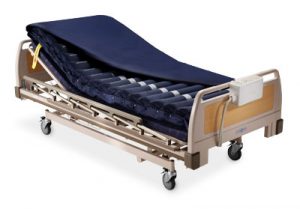
A few companies that supply ripple mattresses are listed as follows:
- Ce Mobility (https://cemobility.co.za/product/ripple-mattress/)
- PrimaCare (https://www.primacare.co.za/)
- Stryker (https://www.medicalexpo.com/prod/stryker-acute-care-107983.html)
- Wissner Bosserhoff (https://www.wi-bo.com/en-DE/)
End