Introduction (SARI)
As a certified professional clinical engineering consultant as well as a certified project manager in a multitude of techniques, I am able to use my project management skills to bolster and provide the best solution to all my customers. I have been actively involved in the medical industry for over 30 years, primarily concerning medical devices and healthcare facilities. Medical device management and implementation of a large facility for over 15 years has given me insight to what is really needed for implementation and service delivery. My experience includes all aspects of medical devices, healthcare facilities and workflows and has given me unique insight to be able to advise on healthcare projects with a high level of success, and positive outcomes
The situation (SARI)

The Corona-virus (Covid19) pandemic is unfortunately an overwhelming situation in that it has many service providers scrambling to provide solutions to healthcare facility optimization.
No one is on his own even though it may feel as if they are. The tragic and unfortunate consequences are a stress on all including: private and public healthcare as well as medical devices suppliers and all related professions. This situation has pointed towards requiring solutions that are efficient, cost effective and timely. I mention timely as the pandemic waits for no one and if project management processes do not optimize fundamental requirements, solutions will always be sub-optimal something no one can afford to take lightly.
There is reliable medical information that Covid19 will be around for a considerable amount of time and with that in mind everyone and all professions, should make best use of time to learn from the current situation and plan for the future and act accordingly for the best outcome. What I do not see, and there may be a lack of time to document accordingly due to the pressure of the current situation, are simple specific LESSONS LEARNT documents. This would release valuable information and recommendations and suggestions on what works and does not work, based on the current situation. While there are drafts and plans for projected situations, a best plan is one made based on current relevant experience. Many countries have gone through what others still will experience and there will always be an aspect of leaders and followers and value in targeted advice through experience based on best scientific data at the time.
SARI Solutions
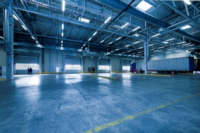
There are a few different types of project solutions regarding treatment centers for the severe acute respiratory infections (SARI). They are not limited to but generally are, adapting a current medical facility or installing a pre-planned ready to go solution of fixed size and structure with all requirements catered for in the design. There is also a solution that is currently being used very successfully and that is one that makes use of a current infrastructure by adapting a large building structure normally utilized for other purposes as a converted center to treat patients.
With the pandemic being of a scale the world is experiencing, and the need for a quick response, the adapting of these large existing structures in the vicinity of large populations is an efficient solution. It provides the ability to address an aspect of the treatment of patients that can take the burden off health facilities. The health facilities are needed with their infrastructure to treat the most severe cases. They can however have workflow adaptions within their processes to convert areas to not only provide a high level of care to Covid19 patients in an isolated manner but also provide healthcare to the public needing normal and critical care for other medical related conditions and services.
Concentrating on the utilization of large SARI infrastructures as a treatment area, has many more advantages than disadvantages and is being used highly successfully throughout the world. It is very important when deciding on which structures to use, to keeping in mind which may have to return to their original use prior to the end of the pandemic. Buildings such as school halls, hotel accommodation, university complexes, large warehousing complexes may have to revert to their original function depending on the stage of the pandemic. If they are being used for patient care and treatment it will not be possible without re-planning additional services in other structures to allow normal services to resume. Therefore, buildings such as Conference centers are a very efficacious choice for SARI.
The standalone solution even prefab and temporary while very successful relies on construction that requires all aspects of services to be implemented, while those services may already exist in other existing facilities and locations. If implemented in advance prior to widespread infection in a community within the time lines for construction this can be a very successful solution for this type of pandemic. This structure would also be very relevant in outlying areas when pre-existing structures cannot be adapted necessitating transport of infected patients to areas that may be relatively infection free. This temporary type of construction would help with isolation and is based on isolation of patients in communities away from limited healthcare services so as not to impact on those limited facilities.
It is of critical importance when adapting and providing a facility for SARI to deal with basic up-front requirements that need to be evaluated and established before embarking on the design and construction or modification. If for example the focus and design could be a first line field hospital or facility to provide a solution primarily for non-critical patients. This solution will allow for a reduction of the potential masses of less severely infected patients from over burdening major medical facilities and allowing medical facilities to treat the more serious infections. This type of facility will have a totally different design, workflow, cost and timeline for adaption when compared to a higher-level facility design. (and will still need a small capability of dealing with critically ill patients as well as a well-functioning referral system)
Many companies are providing solution proposals for their facilities as SARI centers in an isolated manner which is well meaning but may not provide an optimum solution. A full effort with all subject matter experts needs to be entertained with input from the official healthcare authorities and emergency and disaster management teams in a structured approach. As an example, when these authorities (Health, Disaster Management etc) decide to adapt buildings such as sports stadiums (Indoor or outdoor) and conference centers there needs to be a detailed charter, plan, schedule, operating structure, cost etc. A healthy project management approach must be adopted.
As detailed a SARI facility can be used for a front-line field setup, with limited services and a workflow to move patients when they become more critical to step up health facilities or other adapted facilities. Alternately it could have an internal workflow to move these patients to areas within the facility that provide a higher level of care by design, careful planning and foresight. A very innovative approach is to create many modular duplicate areas within the main area (such as a large conference facility). Each of these modular (fixed smaller bed capacity areas) would have all the basics regarding isolation, all services, and workflow but not have everything from a medical device aspect implemented, only the necessary basics, as a baseline.
These areas can then manage patients that do not need the critical care and it would be addressed as a low level of care facility within areas. As the profile changes and the patients start showing more severe symptoms through the natural progression of the disease the areas can be quickly changed to higher levels of care. Re-structuring of areas and addition of equipment and portable isolation and infrastructure will result in a higher level of care without rebuilding and designing. Patients requiring these services can be moved internally if necessary, to allow for better utilization of nursing staff and medical practitioners as well necessary patient monitoring and services requiring a clinical information system and central stations. This requires innovative planning and can be aligned to the Agile Project Management process using the MOSCOW technique. (I will cover that approach and how it could work in another article, but if more information is needed prior to then please contact me in the interim).
Entry and exit criteria of a particular facility with respect to patient care is the first requirement. Health authorities need to indicate what type of patients are going to be need to be treated through the whole process from admission to discharge in the various facilities and this would include the triage process. This detail will ensure plans are put in place to address the more serious patients that may arrive at the facility and those that become more ill in the facility. Bed numbers are not a prerequisite in the beginning as it may seem that is a simple exercise to divide the area into a number of beds based recommended design layout according to spacing. This will not always work effectively but it may work to have a patient in some form of bed with some form of care will serve a purpose. Once the profile of services to be rendered is addressed the medical planner, clinical engineer and architect can quickly start to plan from top down using general accommodation requirements and all necessary services and supportive infrastructure. If, however you have the appropriately qualified and experienced experts in place this can be identified efficiently for many different facilities.
SARI Centers Workflow
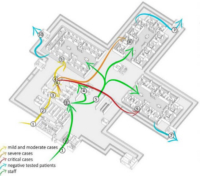 Very important factors to take into consideration re SARI centers are workflows and movement/access flows. These are especially important when dealing with infectious diseases. It is not only the patient management workflow but the medical staff workflow, the non-medical services workflow such as cleaners, catering, technical medical and non-medical, and security. It is also the workflow at the admissions area prior to entering the facility as well as vehicle movement (official and private). Depending on the facility some workflows would already be in place for provision of essentials such as catering, cleaning of utensils and other basic services will have to be adapted with a one-way traffic approach. These workflows should start as a top down approach re access to the building and areas and then refined based on construction of the areas within the facility focused around medical care for treatment
General architect layouts of infrastructures are available and the general overriding movement and workflows can be quickly achieved by use of one or two brain storming sessions with the necessary medical and non-medical staff involved to cover all aspects. General areas such as catering, storage, cleaning ablution access and other critical services and related requirements can be structured within the facility taking the overriding workflows into consideration. A second round of workflow and personal and patient movement can be planned and refined around these services.
Once this is established the detail to beds services, equipment storage, areas can be identified and bed numbers and breakdown for critical areas can be concluded to a high level of confidence. Depending on the need and patient load/burden there will need to be more detailed decision making around the various areas of support. As an example, how many consumables per patient and associated areas required per level of patient care for storage, taking into consideration delivery times can now be identified.
Many SARI designs find out afterwards they have too much wasted storage space or too little or forgotten services to support the abnormal patient, personnel and support functions. Take into mind all service providers will be working under very stressful conditions and everything must be expedited to make their function as easy as possible. Something that is always possible with large public gathering places as a prime solution is there is already infrastructure in place such as networking and parking areas for erecting of additional temporary buildings. Access routes are known, logistics and loading bay facilities, are in place there are storage areas, often catering facilities are available, movement of the public is known, there are fire evacuation plans. Generally, there is a comprehensive set of services that can be quickly implemented and or modified to allow for a rapid response.
Something that must not be forgotten is the medical devices and required accessories and services required for patient treatment. Each situation will be unique depending on the size and type of establishment and the design and provision of the bill of quantities for devices will be different so there cannot be a one size fits all approach. Initially supply will be an issue as demand exceeds the supply, however certain devices can be purchased that can be programmed to provide different functions. These devices are also going to need backup repair and exchange during the operation of a facility. The content, and numbers and training of staff on devices they may not have been using before, are all essential services to be addressed.
Once again there is no perfect solution and each area, region and country will have their own challenges regarding facilities to address the outbreak. What works in one situation may not work or may work better in another. A well-recognized project management process by a Project Management Professional (PMP) with an Agile Practitioner Certification makes a big difference, allows for a more efficacious strategy and there will be a process of continual improvement. Tailoring the best from all methodologies and bodies of knowledge, providing the minimum of what is needed to start the process and then adding to and improving to provide for a total solution, would be the wisest choice of approach.
Conclusion

It is important to learn from this unfortunate situation and create future plans and processes to allow for a rapid response should a similar event ever occur. This should all be documented in lessons learnt and put into future disaster planning and also cater for covering projected situations that may have the potential for being even more harmful than what we are currently experiencing.
It is also important to remember relating to Covid19, that this too shall pass. It is however an important reminder that we are all vulnerable to unfortunate disease outbreaks and we experience them on a daily basis, but not to the magnitude of our current challenge. At times like this just as in other tragic events such as 911 and other disasters, we need to be appreciative of all of the professional services staff that are tirelessly putting their lives on the line and working long hours to provide critical services. These professionals from cleaners, contractors, engineers, all the way up to nurses’, doctors, firemen, and all professional and government service that are involved in a sacrifice of self, do not only deserve our sincere gratitude but deserve an extra-ordinary response from us in order to make their efforts towards curbing this pandemic less strenuous and more effective.
For any questions regarding SARI, please contact me via my website.